
Vterra—The Architecture
Why the platform is built the way it is
Most AI platforms are built around a single capability: generate text, analyze data, automate a task. Vterra is built around a different proposition entirely. What does an organization need in order to make every decision, every resource allocation, and every operational priority genuinely serve the value it exists to create? The architecture follows from that question.
The Vterra architecture ensures that AI serves your organization in a consistent, governable manner.
The Problem Vterra Is Architected to Solve
The drift described in the video above is not a failure that shows up on a dashboard. It is erosion: gradual, systemic, and self-reinforcing. The longer it goes unexamined, the more resources—already limited in mid-size organizations—are directed toward optimizing a system that may be doing the wrong things efficiently. By the time the drift is recognized, it has become structurally solidified into habits, reporting cycles, and the quiet assumptions of everyone involved.
Most organizations respond by adding more information. Better data, faster analytics, more advanced AI. In practice, this is the opposite of what is needed. More information without more interpretive structure produces more noise. The gap between what is being done and what the organization exists to create does not close—it becomes harder to see.
Vterra is architected to interrupt that pattern. Not by generating more information, but by providing the structure through which information becomes meaning, and meaning becomes coherent action.
One Platform, Two Integrated Layers
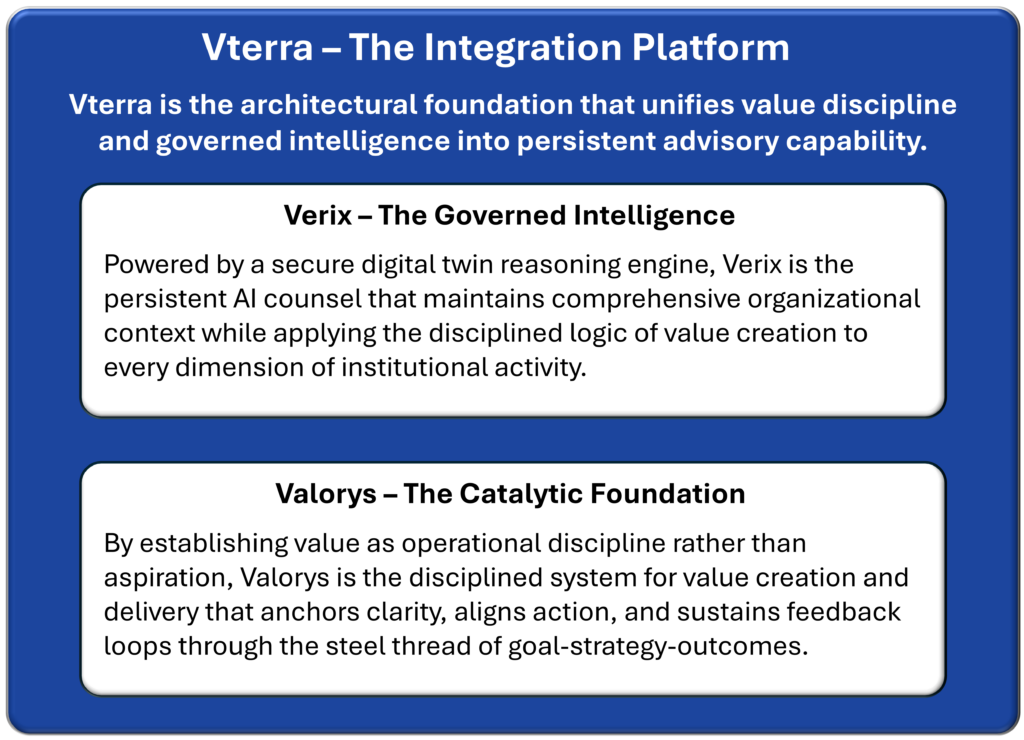
Vterra operates as a layered system. The two layers are not independent products that happen to be bundled together. They are designed to work in sequence: one establishes what the organization exists to create; the other brings an advisory presence to bear on that question in real time.
This combination is not incidental. A reasoning engine without a governing framework produces capable but directionless outputs. A governing framework without a reasoning engine is a document that sits in a drawer. Together, they create something that neither achieves alone: advisory intelligence that is anchored to purpose.
The Digital Twin
Within the Verix component of the Vterra architecture is the digital twin—the organizational knowledge repository that Verix draws from when reasoning about a specific challenge. This is where the platform becomes genuinely differentiated from any general-purpose AI tool.
When a leader brings a question to Verix, the response is not generated from the internet or from aggregate training data. It is reasoned from the organization’s own context: its financials, its strategic priorities, its compliance environment, its historical decisions, its competitive landscape. The digital twin is populated by the organization itself, behind its own firewall, on infrastructure it controls entirely.
This has two important consequences. First, the advice is contextually grounded in a way that no external advisory tool can replicate—because no external tool has access to the organization’s actual operating reality. Second, the institutional knowledge that accumulates inside the digital twin over time becomes a compounding organizational asset rather than something that walks out the door when people leave.
The digital twin compounds institutional knowledge over time. The advice becomes more precise as the context becomes richer.
Why the Value Framework Comes First
Vterra does not begin with automation or tools. It begins by establishing shared direction. This sequencing is deliberate and reflects a considered position on why most AI deployments underdeliver.
According to BCG’s 2024 analysis, while 72% of organizations have adopted some form of AI and global investments exceed $560 billion, 74% have yet to demonstrate tangible value from that investment. The problem is not the technology. The problem is that organizations are deploying AI into a context that lacks the interpretive structure needed to make its outputs actionable. More intelligence without more clarity produces more noise.
Vterra’s architecture inverts this sequence. Establish the value framework first, load the organizational context second, and let the AI reason from that foundation third. The result is not faster activity, it is more coherent action. And over time, an organization becomes measurably more capable of maintaining alignment between what it is doing and what it exists to create.
For Leaders Who Are Accountable for Outcomes
The Vterra architecture is designed for the leader who is accountable for outcomes, not just for activity. For the CEO who needs to know whether the organization is actually closing the gap between what it was created to do and what it is delivering. For the CIO who needs to know whether the technology investments are producing genuine value or impressive dashboards. For the board member who needs to know whether the organization’s AI adoption is principled, governed, and pointed in the right direction.
None of these leaders needs another tool that generates output. They need a platform that keeps insight, authority, and action connected as conditions change. That is what the Vterra architecture is designed to do.