
How It Works
One platform. Three interdependent components. Built to work as one.
Most platforms solve one organizational problem. Vterra was architected to solve three simultaneously—because the problems are connected, and a solution that addresses only one of them is not a solution at all.
Why One-Dimensional Solutions Fail
Every existing solution addresses one problem. That's why they all fall short.
AI tools help with adoption but don’t understand your organization’s values. Consultants provide clarity but cost more than most leaders can afford—and leave when the engagement ends. Open-source frameworks give you a structure but require expensive human deployment. None of them converge. And solving one problem without the others creates new ones.
Comparison Matrix Table
AI tools help with adoption but don’t understand your organization’s values. Consultants provide clarity but cost more than most leaders can afford—and leave when the engagement ends. Open-source frameworks give you a structure but require expensive human deployment. None of them converge. And solving one problem without the others creates new ones.
| AI Tools | Consultants | Frameworks | Vterra | |
|---|---|---|---|---|
| AI Adoption | ✓ | ✗ | ✗ | ✓ |
| Org Clarity | ✗ | Partial | ✓ | ✓ |
| Advisory Access | ✗ | ✗ | ✗ | ✓ |
| Cost | Varies | High | Varies | Free |
Why Vterra is different from anything you've seen before.
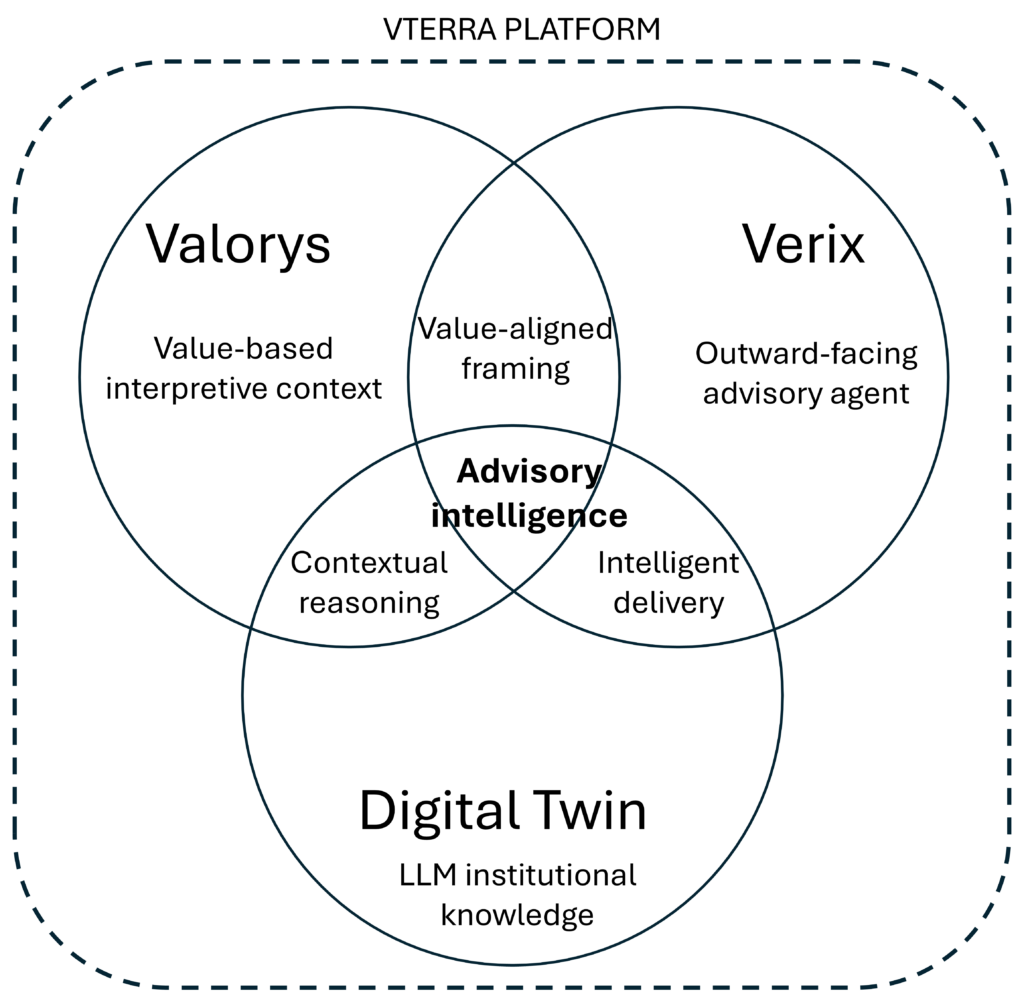
the framework
Valorys
A disciplined system for returning value creation and delivery to an organization’s central pursuit. Valorys is the context layer—the set of principles and amplifiers that provides Verix the ethos needed to render value-centered advisory.
The Agent
Verix
An AI advisory presence that deploys Valorys within your organization’s knowledge base. Verix is the delivery layer—the intelligence that makes the framework accessible to any leader, at any time, without a consultant in the room.
The Architecture
Vterra
The open-source platform that connects Valorys and Verix into a unified system. Vterra is the infrastructure layer—the environment in which the framework and the agent operate together.
How the Three Components Work Together
- Valorys provides the value system that defines what good decisions look like for your organization.
- Verix applies that framework to your questions, your priorities, and your organizational context—not to a generic prompt.
- Vterra connects them and makes the whole system deployable, maintainable, and open to your organization without vendor dependency.
Remove any one component and the system loses its integrity. An AI implementation without a value-based framework produces misaligned output. A framework without an agent requires expensive human deployment. Open infrastructure without both is just empty scaffolding.
The Vterra-Human Metaphor
Vterra is analogous to the human mind as illustrated below. Like an experienced consultant, the Vterra platform uses both logic and guiding principles to advise a client.
Step 1. Question Is Received (Auditory Cortex – Ears) A leader poses a challenge. Verix listens, parses the question, and prepares to reason through it.
Step 2. Answer Is Reasoned (Dorsolateral Prefrontal Cortex + Parietal Lobe) The LLM digital twin applies logic, pattern recognition, and analytical processing to compile a raw response—the same neural machinery humans use for formal reasoning and problem-solving.
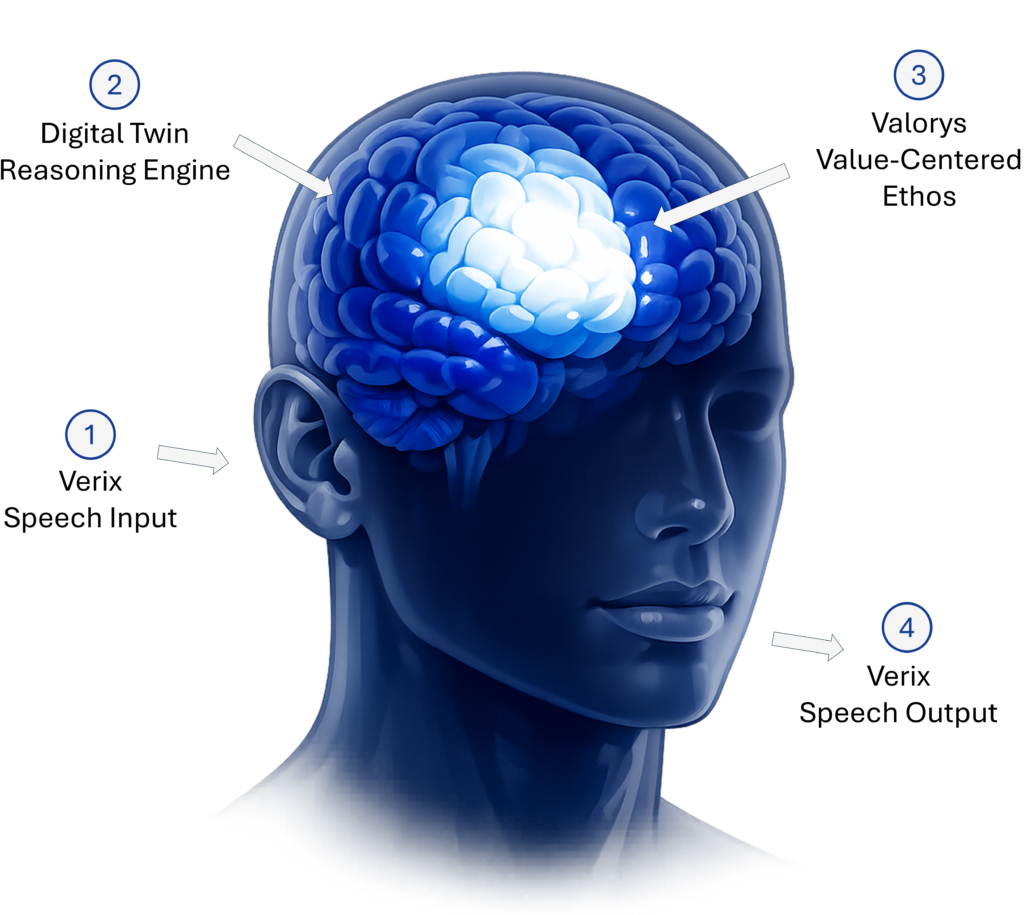
Step 3. Answer Is Filtered for Ethos (Ventromedial Prefrontal Cortex) Before delivery, the response passes through the Valorys framework—the organization’s value system—to ensure every insight is anchored to purpose, context, and integrity.
Step 4. Guidance Is Delivered (Broca’s Area – Mouth) A clear, value-aligned answer is returned to the leader—not just intelligent, but trustworthy.