
The Locus of Value
Valorys integrates across all organizational levels, linking cycles of thought and action with Verix as an operational intelligence engine.
In the contemporary economy, value is not a peripheral concern; it is the organizing principle of enterprise survival and advantage. This post argues that a value-centered approach is far more than rhetorical positioning—it is a fundamental reorientation of how leaders think, structure organizations, and execute work. When value becomes the core lens for judgment and design, organizations of every type—corporate, public, and social—become more discerning, more resilient under constraint, and better able to convert disruption into durable advantage.

This reorientation is captured in the value formula, which links alignment, flow, customer co-creation, adaptive leadership, and value as a multidimensional metric. Alignment gives the enterprise a shared language for strategy through goal-strategy-outcomes (GSO) constructs, ensuring that every contributor understands not only activity but intent. Flow, expressed through value streams, optimizes how offerings move from concept to customer, exposing bottlenecks and waste. Customers are treated as co-creators rather than endpoints, enabling the organization to surface latent needs and build propositions that competitors routinely overlook. Adaptive leaders provide clarity and boundaries, then step back—replacing control with structured autonomy. Value itself becomes the unifying measure, connecting financial returns to purpose, trust, workforce meaning, and societal contribution.
Valorys is presented as the structural embodiment of this philosophy. It frames the enterprise around four perpetual business cycles—Think, Plan, Deliver, Support—that extend and modernize Deming’s PDCA and the scientific method. These cycles form a closed learning loop: strategy and intent flow downward through GSOs, while insight and evidence flow upward through metrics and feedback. Internally, Valorys links leadership judgment, capacity, capabilities, and operations through value streams that traverse traditional functional silos. Externally, it insists on an explicit, evolving understanding of what customers actually prize—from reliability and convenience to trust, privacy, and alignment with personal beliefs—co-created through cross-functional fusion teams working directly with the market.
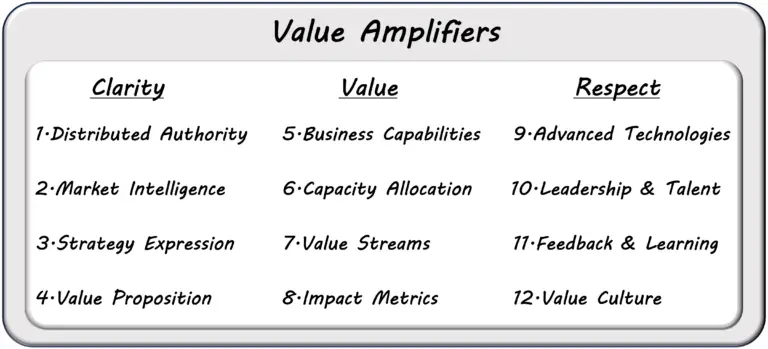
Valorys introduces twelve value amplifiers that convert the construct into a living system. These patterns function as nonlinear levers. They reduce waste, sharpen resource deployment, deepen engagement, and increase the yield on human capital without requiring wholesale restructuring. In practice, they allow enterprises to do more of the right work with fewer resources, while elevating creativity, accountability, and coherence.
Finally, Valorys extends into the domain of intelligent systems through Verix, an AI-enabled implementation layer. Verix operationalizes Valorys by integrating secure enterprise LLMs, generative, analytical, conversational, and agentic AI. Together, they create a synchronic, self-adapting environment where strategy, execution, measurement, and learning are continuously connected. The result is a repeatable rhythm of value creation that links boardroom purpose with frontline action, enabling organizations to navigate complexity with clarity, accelerate impact, and sustain relevance in an economy where value—not scale, not control—has become the true locus of advantage.