
Valorys—The Framework
How Valorys Changes What AI Can Do for Your Organization
Most AI tools give you more information. Valorys gives you a way to understand what that information means—and what to do about it. The distinction is not subtle. It is the difference between noise and direction, between activity and outcomes, between an organization that is busy and one that is actually creating value.
Technology is not the bottleneck. The absence of a framework for interpreting information in service of a clear purpose is.
The Problem Valorys Was Built to Solve
Organizations exist to create and deliver value. This truth, once self-evident to institutional leadership, has been systematically displaced by operational mechanics. What began as necessary attention to process, compliance, and internal coordination has metastasized into an existential inversion: the methods of operation have become the purpose itself.
The result is institutional drift—organizations that function efficiently while failing fundamentally. Executive teams manage budgets, optimize processes, and maintain structures without confronting the essential question of whether these activities generate value for any stakeholder.
When value creation ceases to be the primary operating model, organizations experience what appears to be a diverse array of discrete problems: employee disengagement, customer attrition, innovation paralysis, strategic misalignment, and resource waste. Leadership addresses each symptom independently through targeted interventions—new engagement programs, customer experience initiatives, innovation labs, strategic planning retreats, efficiency drives. Yet the problems persist or recur because they are not independent failures. They are expressions of a single underlying condition: the organization no longer operates according to its primary purpose.
What Valorys Is
Valorys is a structured value creation system. It provides the operating logic through which Vterra reasons, advises, and surfaces what is actually driving or limiting an organization’s performance.
It is not a methodology in the consulting sense—a framework to be installed, presented to the board, and shelved. It is a governing discipline: a continuous, shared practice of asking what value this organization is actually creating, and whether every activity, every decision, and every resource allocation is genuinely aligned to that answer.
When that discipline is woven into how an organization operates—not as a one-time exercise, but as an ongoing loop—organizational drift does not just slow. The organization becomes self-correcting.
Value creation must be treated as a governing discipline, not a hoped-for byproduct.
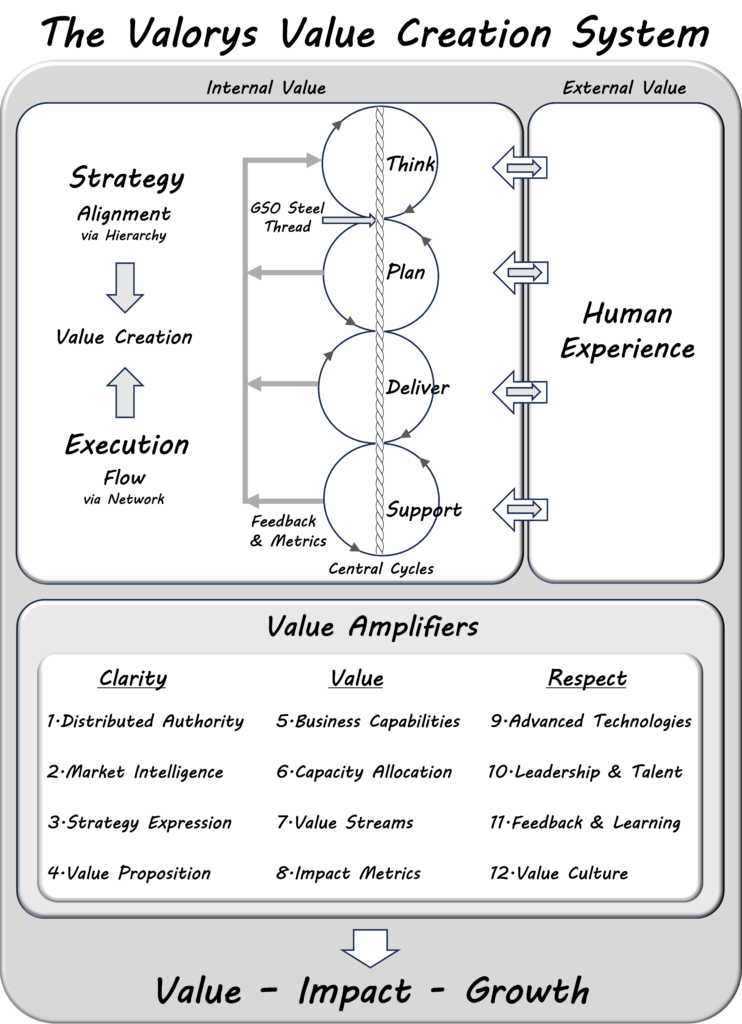
The Twelve Value Amplifiers
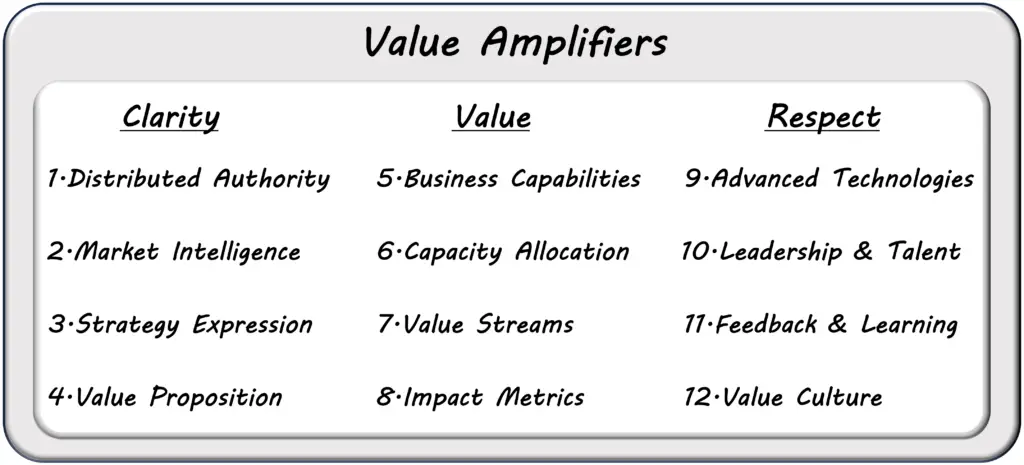
At its core, Valorys operates through twelve Value Amplifiers—the behavioral and structural levers that govern how value is created, encapsulated, and sustained across an organization. These amplifiers address every layer of institutional life: how decisions are made, how authority is distributed, how teams understand their own contribution, how leaders maintain alignment as conditions shift.
Each amplifier represents a dimension where organizations commonly lose ground—not through failure, but through drift. The amplifiers give leaders a precise diagnostic lens: not a generic scorecard, but a structured inquiry into the specific mechanisms that are either accelerating or constraining value creation in their particular context.
The Twelve Value Amplifiers Address How:
- Value is defined and made visible across the organization
- Authority is distributed to the points where value is actually created
- Decisions are filtered through a shared understanding of purpose
- Teams maintain alignment as conditions and pressures change
- Institutional knowledge is preserved and compounded over time
- Leaders distinguish between activity and genuine impact
- The gap between effort and outcome is surfaced and closed
Evidence-Based Judgment
One of Valorys’s central contributions is replacing intuition-driven decision-making with evidence-based judgment. These are not the same thing, and the confusion between them is costly.
Intuition is pattern recognition. It works well in familiar conditions and fails silently in unfamiliar ones. Leaders who have operated in a particular sector for many years develop strong intuitions—and those intuitions can become liabilities when the context shifts in ways that are subtle rather than dramatic.
Evidence-based judgment means something more disciplined: that every significant decision is tested against observable data, interpreted through a shared value framework, and evaluated for its likely impact on what the organization exists to create. Not paralysis by analysis—but a structured refusal to act on assumption when reality is available.
Valorys provides the interpretive architecture that makes this possible—not as a theoretical exercise, but as an operational discipline that can be practiced at every level of the organization.
Distributed Authority
One of the most consistent findings in organizational performance is that authority concentrates upward as complexity increases—and that this concentration is one of the primary mechanisms through which value is lost.
When decisions are made by people who are furthest from the point of value creation, those decisions are structurally likely to miss the nuance that proximity would have provided. Speed decreases. Accountability diffuses. The organization becomes reactive rather than responsive.
Valorys addresses this directly. Its governing principle is that authority should sit as close as possible to where value is created—and that the role of senior leadership is to provide direction and clarity, not to concentrate decision rights. This is not a management preference. It is a structural requirement for sustained performance.
In an AI-enabled world, the competitive advantage is not intelligence itself, but the capacity to employ it in service of realized value.
How Valorys Connects to Verix and the Vterra Platform
Valorys is the contextual engine behind Verix—the AI advisory agent that leaders engage through the Vterra platform. When a leader brings a challenge to Verix, it does not generate generic recommendations. It interprets the challenge through the Valorys value framework: surfacing what is actually at stake, identifying where the gap between purpose and performance lies, and helping the leader find the path toward closing it.
The digital twin architecture compounds this further. As an organization loads its own operational data—financials, strategic priorities, team structures, historical decisions—the Valorys framework interprets that data in context. The advice becomes more precise over time because the context becomes richer. This is not a static tool. It is a learning system guided by a principled framework.
Why This Matters for Mid-Size Organizations
High-quality strategic advisory grounded in a rigorous value framework has, until now, been available primarily to organizations with the resources to retain firms that charge accordingly. The intelligence existed. Access to it was rationed by budget.
Vterra changes that equation. The Valorys framework—and the advisory capability it makes possible—is available to every organization that chooses to deploy it, at no cost, without vendor lock-in, and without the conflict of interest that comes with paid advisory relationships.
For a mid-size company trying to sustain growth through a difficult market, a nonprofit trying to demonstrate genuine impact to skeptical funders, a government agency trying to close the gap between mandate and delivery, or an NGO trying to scale programs that work—the Valorys framework provides what has previously been inaccessible: a structured, evidence-based discipline for ensuring that everything the organization does is genuinely aligned to the value it exists to create.
Explore the Valorys Framework in Depth
The Book
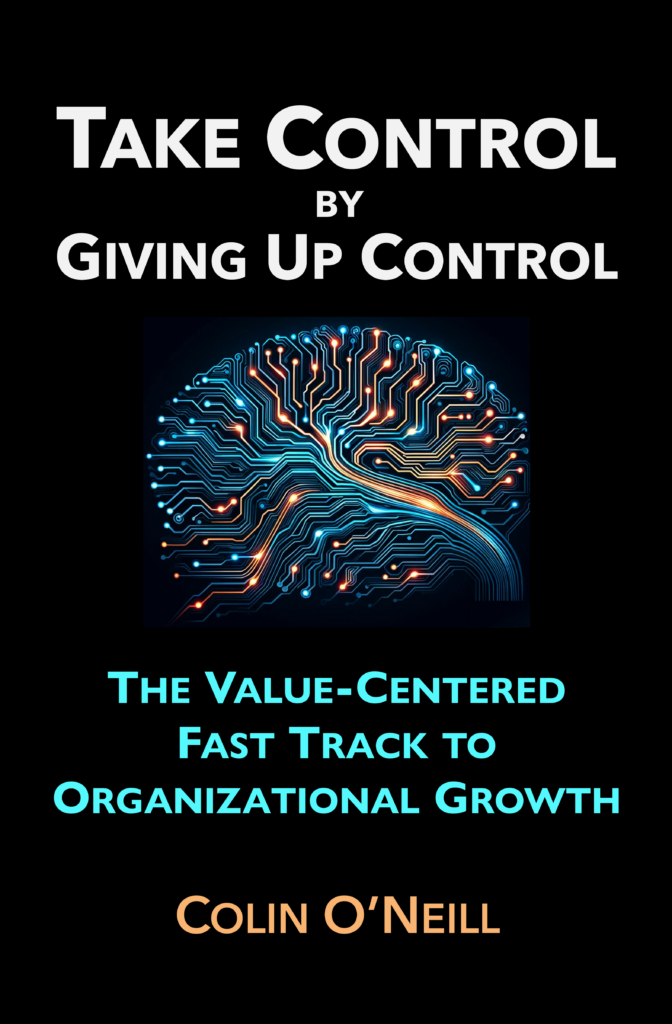
Valorys is comprehensively documented in the book Take Control By Giving Up Control: The Value-Centered Fast Track to Organizational Growth.