
Verix—The Agent
Why AI Advisory Needs a Human Presence
Most AI tools respond to queries. Verix does something different: it engages in the kind of structured, purposeful conversation that has historically been the domain of senior advisors—asking the questions that surface what is actually driving an organization’s performance, reflecting back what it hears with precision, and helping leaders see their situation more clearly than they could from inside it.
This distinction matters because the value of advisory is not primarily in the answers it provides. It is in the quality of the questions it asks, and in the discipline it brings to interpreting what the answers reveal.
The right questions surface more value than prescribed answers. Verix is built on that premise.
What Verix Is
Verix is an AI advisory agent grounded in the Valorys value creation framework. It is the conversational interface through which the Vterra platform delivers guidance—in real time, in natural language, through a presence that is designed to feel like a conversation with a senior advisor rather than a query submitted to a database.
The humanoid presentation is not cosmetic. It reflects a considered position on how advisory relationships work. Executives engage more deeply with a presence that communicates as a person communicates—with tone, with timing, with the ability to pause and ask a follow-up question. The humanoid format reduces the psychological distance between the leader and the advisory capability, which matters because the value of advisory depends entirely on the depth of engagement it produces.
What Verix Is Actually Doing When You Interact With It
When a leader engages Verix with a challenge, the agent is not performing a database search or generating a generic response from its training data. It is reasoning from the organization’s own context—the knowledge repository that has been built into the digital twin—and interpreting that context through the Valorys value framework.
This means the guidance Verix provides is contextually grounded in a way that no general-purpose AI tool can replicate. The response to a question about resource allocation is not a best-practice answer drawn from the internet. It is an interpretation of this organization’s actual priorities, its current constraints, and its strategic direction, filtered through a framework designed to keep every recommendation anchored to value creation.
Step 1. Question Is Received (Auditory Cortex – Ears) A leader poses a challenge. Verix listens, parses the question, and prepares to reason through it.
Step 2. Answer Is Reasoned (Dorsolateral Prefrontal Cortex + Parietal Lobe) The LLM applies logic, pattern recognition, and analytical processing to compile a raw response—the same neural machinery humans use for formal reasoning and problem-solving.
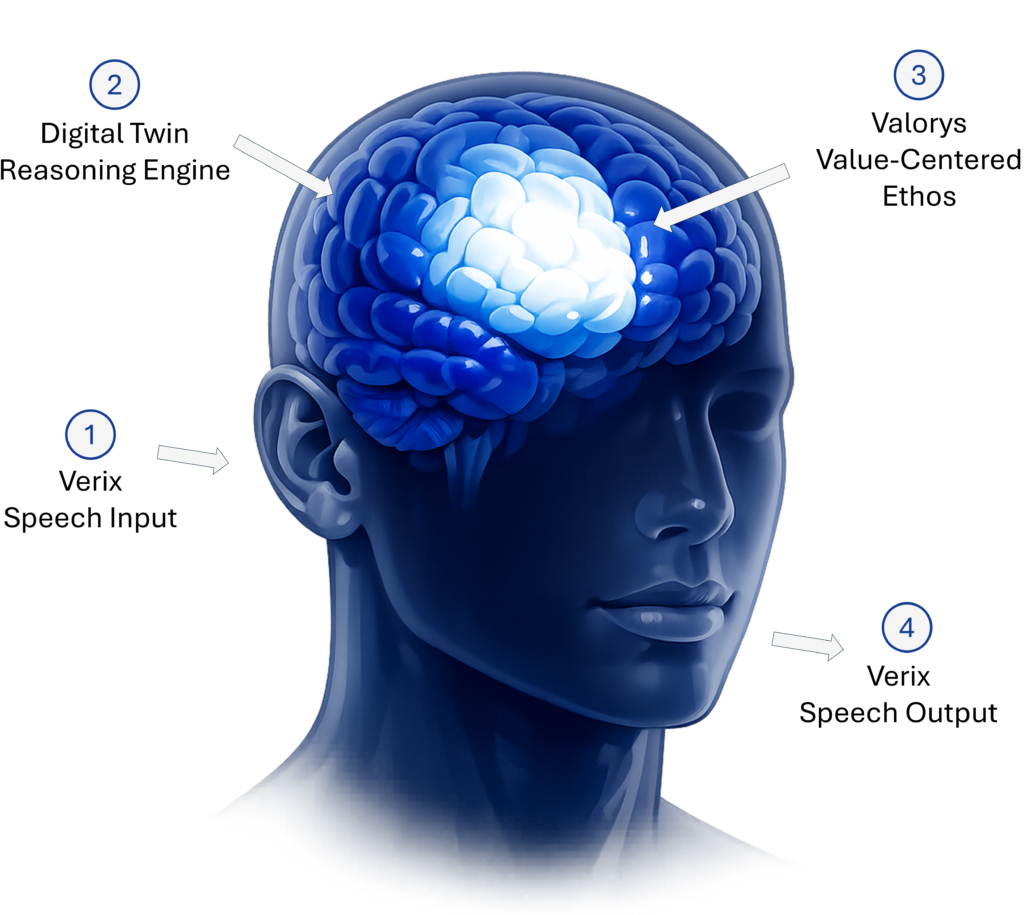
Step 3. Answer Is Filtered for Ethos (Ventromedial Prefrontal Cortex) Before delivery, the response passes through the Valorys framework—the organization’s value system—to ensure every insight is anchored to purpose, context, and integrity.
Step 4. Guidance Is Delivered (Broca’s Area – Mouth) A clear, value-aligned answer is returned to the leader—not just intelligent, but trustworthy.
The Verix Experience
The Verix agent demo is designed as a discovery conversation. It is not a search interface. It is an open conversation with a real leader about a real organizational challenge.
Verix opens by establishing context: what is the gap between what the organization was created to do and what it is actually delivering. Most leaders pause at that last question. The pause is the value—because it surfaces, often for the first time in explicit form, the tension that has been driving the organization’s presenting symptoms.
From there, the conversation follows the leader’s thread. Verix names patterns and identifies where the diagnostic questions of the Valorys framework are most relevant. The Torvin demonstration shows what the full platform looks like when deployed inside your specific organizational context.
The Torvin Demonstration
The Torvin demonstration is a closed-context Verix instance pre-loaded with the full operational profile of a fictional insurance organization. The demo begins with everything already in place: the organization’s strategic priorities, its value gaps, its team structure, its challenges.
This allows a visitor to see what Verix looks like when it is fully operational—not as a demonstration of its conversational capabilities, but as a demonstration of its advisory depth. The difference between the two experiences is the difference between a conversation with a new advisor who is building context, and a conversation with a trusted advisor who already knows your organization. The Torvin demo shows the latter.
What Verix draws from in every conversation:
- The organization’s own operational data: Financials, program outcomes, strategic priorities
- The Valorys value creation framework: The interpretive structure that keeps guidance anchored to purpose
- The evolution of the digital twin: Accumulated institutional knowledge which compounds over time
- The conversation itself: Verix builds context through the exchange, not before it
Verix does not tell leaders what to do. It helps them see their situation more clearly than they could from the inside.
What Changes When Value Creation Is Operational
Organizations that have deployed AI as a point solution—a tool for drafting content, generating reports, or automating routine tasks—have discovered that capability without a governing framework produces more noise than clarity. The tools are capable. The framework for interpreting their outputs and directing their use is absent.
When value creation becomes the operational foundation, and AI serves that foundation rather than operating independently of it, the experience is qualitatively different. Leaders act with clarity rather than reacting to fragmented signals. Teams understand how their work drives outcomes, not just how it complies with process. Decisions reflect shared priorities grounded in current intelligence. AI becomes stabilizing infrastructure—helping an organization maintain alignment as conditions shift, rather than adding to the complexity that leaders are already navigating.
What Verix Does Not Do:
- Automate decisions or remove human accountability
- Generate recommendations from generic training data rather than organizational context
- Claim certainty where context or data are insufficient
- Issue directives or mandate behavior
- Operate outside its established scope without flagging the boundary
- Access external data about your organization without your explicit loading of it
These constraints are not limitations. They are the architecture of a trustworthy advisory tool. The value of Verix is precisely that it stays inside what it knows, asks when it needs more context, and always leaves the decision—and the accountability—with the leader.