
the framework
A disciplined system for returning value creation and delivery to an organization’s central pursuit.
the principles
The principles that govern how Vterra is deployed and operated, and why they matter now.
the model
Why free and open-source is the only model that makes sense for a platform built on the premise of no hidden agenda.
Step 1. Question Is Received (Auditory Cortex – Ears) A leader poses a challenge. Verix listens, parses the question, and prepares to reason through it.
Step 2. Answer Is Reasoned (Dorsolateral Prefrontal Cortex + Parietal Lobe) The LLM applies logic, pattern recognition, and analytical processing to compile a raw response—the same neural machinery humans use for formal reasoning and problem-solving.

Step 3. Answer Is Filtered for Ethos (Ventromedial Prefrontal Cortex) Before delivery, the response passes through the Valorys framework—the organization’s value system—to ensure every insight is anchored to purpose, context, and integrity.
Step 4. Guidance Is Delivered (Broca’s Area – Mouth) A clear, value-aligned answer is returned to the leader—not just intelligent, but trustworthy.
Decisions grounded in your vision, your priorities, and your organizational reality—not generic best practices that may or may not apply to your context.
An intelligent reasoning partner available at any hour, for any question, without an invoice. The kind of access that was previously rationed by budget.
No vendor lock-in. No subscription dependency. No hidden agenda. The platform is yours—open-source, deployable on your infrastructure, governed by your values.
The three challenges that brought you here—AI adoption, organizational clarity, and access to quality advisory—share a common root cause. Organizations that have drifted from their core purpose cannot use AI intelligently because they lack the interpretive structure that makes AI outputs meaningful. Valorys is that structure.
Most AI tools give you more information. Valorys gives you a way to understand what that information means—and what to do about it. The distinction is not subtle. It is the difference between noise and direction, between activity and outcomes, between an organization that is busy and one that is creating real value.
Technology is not the bottleneck. The absence of a framework for interpreting information in service of a clear purpose is.
Organizations exist to create and deliver value. This truth, once self-evident to institutional leadership, has been systematically displaced by operational mechanics. What began as necessary attention to process, compliance, and internal coordination has metastasized into an existential inversion: the methods of operation have become the purpose itself.
The result is institutional drift—organizations that function efficiently while failing fundamentally. Executive teams manage budgets, optimize processes, and maintain structures without confronting the essential question of whether these activities generate value for any stakeholder.
When value creation ceases to be the primary operating model, organizations experience what appears to be a diverse array of discrete problems: employee disengagement, customer attrition, innovation paralysis, strategic misalignment, and resource waste. Leadership addresses each symptom independently through targeted interventions—new engagement programs, customer experience initiatives, innovation labs, strategic planning retreats, efficiency drives. Yet the problems persist or recur because they are not independent failures. They are expressions of a single underlying condition: the organization no longer operates according to its primary purpose.
AI entirely changes how leaders think about large bodies of organizational information. Instead of needing to know exactly what question to ask and where the answer lives, the system becomes a thinking partner that can surface patterns, reveal gaps, and generate insight from information that previously required a team of analysts to synthesize. The value of data stops being locked in the precision of your query and starts being unlocked by the quality of your thinking and the expanse of your imagination.
A traditional relational database is a highly structured filing system—it stores information in rigid rows and columns, and it can only return what you explicitly ask for using precise queries. It has no understanding of meaning, context, or intent, only location and syntax.
The Voxyn digital twin is fundamentally different, pairing a large language model (LLM) with retrieval-augmented generation (RAG). The LLM brings deep semantic understanding of language and concepts, while RAG dynamically pulls relevant information from large document stores and feeds it into that reasoning engine in real time. So instead of running an exact-match query, you’re asking a system that understands your question, retrieves contextually relevant information, and synthesizes a reasoned response across sources that may never have been explicitly connected.
The power difference is not just speed or scale—it’s the shift from retrieval to reasoning: a relational database tells you what’s there, while an LLM/RAG system tells you what it means, what’s missing, what’s contradictory, and what conclusions follow.
Vterra reasons the way an experienced advisor does—listening, applying logic, filtering for context, then delivering.
Step 1. Question Received (Auditory Cortex) Voxyn listens and parses the challenge.
Step 2. Answer Reasoned (Dorsolateral Prefrontal Cortex + Parietal Lobe) The LLM/RAG applies logic and pattern recognition to compile a raw response.
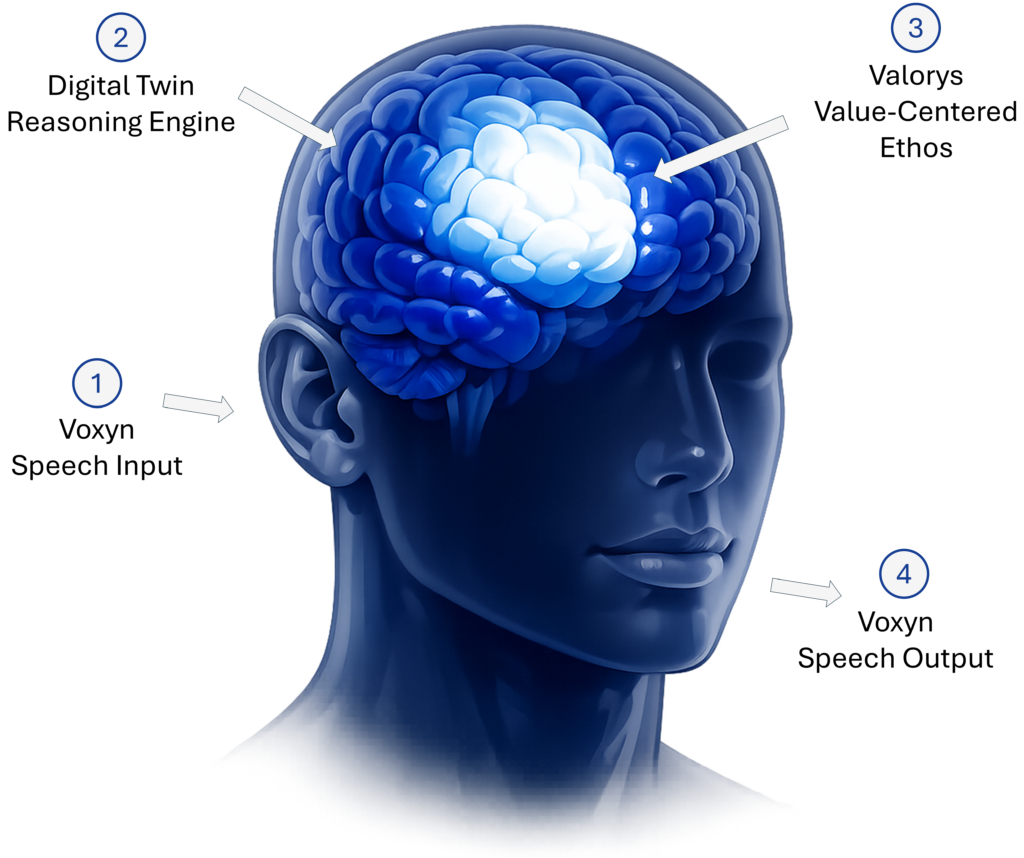
Step 3. Answer Filtered for Ethos (Ventromedial Prefrontal Cortex) The response passes through the Valorys framework, anchoring it to value creation and the organization’s purpose.
Step 4. Guidance Delivered (Broca’s Area) A reasoned, value-aligned answer is returned to the leader. Not just intelligent—trustworthy.
Most organizations were built around a clear purpose. Over time, that purpose gets displaced—not dramatically, but gradually, as operational mechanics accumulate weight. Compliance requirements, reporting cycles, and process management begin to consume the attention originally directed at the value the organization exists to create.
The result is institutional erosion. Not failure—the dashboards still look acceptable. But somewhere in the gap between what leadership intends and what the organization actually does, the connection to core purpose quietly weakens.
Valorys is a disciplined system built specifically to interrupt that pattern—not by adding more process, but by providing the interpretive framework that keeps the connection between daily work and core purpose visible, testable, and correctable. It operates through twelve value amplifiers: the specific behavioral and structural levers through which value is created, sustained, and compounded across an organization. When that framework is woven into how an organization operates as a continuous discipline, the drift does not just slow. The organization becomes self-correcting.
Value creation must be treated as a governing discipline—not a hoped-for byproduct.
Every organization accumulates knowledge—about what works, what doesn’t, why certain decisions were made, what the organization tried three years ago and abandoned, and why. That knowledge lives in the minds of the people who were there. When those people leave, it leaves with them.
What remains is a set of outcomes without context. New leaders inherit results without the reasoning that produced them. Decisions get relitigated because no one remembers they were already made. The organization encounters the same problems repeatedly—not because it lacks intelligence, but because it has no structured way to retain what it has learned.
Compared to a traditional relational database, an AI vector database works on an entirely different principle: instead of storing raw data, it stores information as embeddings—high-dimensional numerical representations that encode the semantic meaning of text, images, or other content. When you search a vector database, you’re not matching exact values; you’re measuring the geometric distance between your query’s meaning and the meaning of everything stored, returning results that are conceptually closest, even if they share no keywords in common.
The digital twin is a living, vector-based knowledge repository—a continuously updated record that captures what your organization knows and makes it available when it matters. It does not replace human judgment. It gives human judgment the institutional memory it has always needed but rarely had. And it is what makes Voxyn’s guidance specific to your organization rather than generic to all organizations.
Institutional knowledge should compound over time—not disappear every time someone walks out the door.
The best advisory relationships share a common characteristic: the advisor knows the client’s organization from the inside—from sustained, contextual engagement with its priorities, its dynamics, its history of decisions, and the gap between what it says it’s doing and what’s actually happening. That depth of knowledge is what makes advice genuinely useful rather than generically correct. And it is what has always made great advisory expensive.
For the city manager, the nonprofit executive director, the federal field office director, the training commander—the cost of building that context with a qualified external advisor has never been justifiable. They are left with advisors who don’t know their organization, or no advisor at all.
Vterra changes that equation through two components working in sequence. Voxyn draws from your organization’s digital twin knowledge repository and delivers reasoning through a conversational humanoid presence—an advisor you can have a real conversation with, available at any hour, with no invoice and no conflict of interest.
The depth of knowledge that makes advice genuinely useful has always taken time and money to build—and left when the engagement ended.
When leaders first encounter Vterra, the question that follows immediately is: what is the catch? The subscription model has trained everyone to expect that free means temporary. None of that applies here, and the reason is structural rather than rhetorical.
Vterra is free because a paid model directly contradicts its premise. A platform that charges for access to advisory intelligence is still rationing it by budget. It has only moved the price point. The open-source architecture goes further: your organization owns its deployment entirely—behind your own firewall, on your own infrastructure, with a GPT you control. Your digital twin belongs to you. The platform is released under the Apache License 2.0: yours to use, adapt, and extend.
Real advice requires knowing your reality. That has never been free—until now.