
Valorys is a structured value creation system. It provides the operating logic through which Vterra reasons, advises, and surfaces what is actually driving or limiting an organization’s performance.
It is not a methodology in the consulting sense—a framework to be installed and shelved. It is a governing discipline: a continuous practice of asking what value an organization is actually creating, and whether every activity, every decision, and every resource allocation is genuinely aligned to that answer.
When that discipline is woven into how an organization operates—not as a one-time exercise, but as an ongoing loop—organizational drift does not just slow. The organization becomes self-correcting.
For a full examination of how drift compounds—and why conventional improvement efforts cannot reverse it from within, read The Value Crisis.
Valorys is not speculative, but a battle-tested architecture for institutional transformation, born from the crucible of the most challenging consulting assignments and refined through adversity. It is designed to sharpen strategic focus, streamline complexity, reduce operating costs, and accelerate enterprise-level returns. At the same time, it preserves what matters most: the autonomy and creative latitude professionals require to excel.
Through this architecture, organizations move beyond brittle, legacy constructs and toward responsive, integrated models better suited to the dynamic conditions in which they now operate. Valorys is not a panacea, nor does it promise transformation through radical reorganization. Instead, it reinvigorates institutions through behavioral alignment, strategic clarity, and minimal disruption.
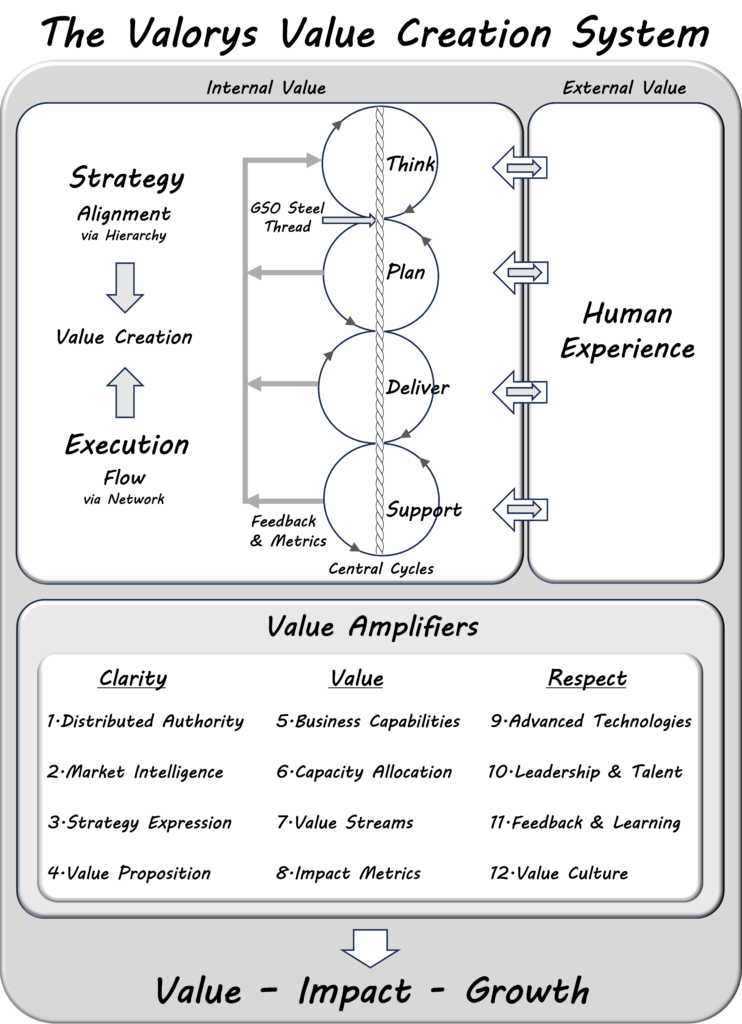
Value creation must be treated as a governing discipline, not a hoped-for byproduct.
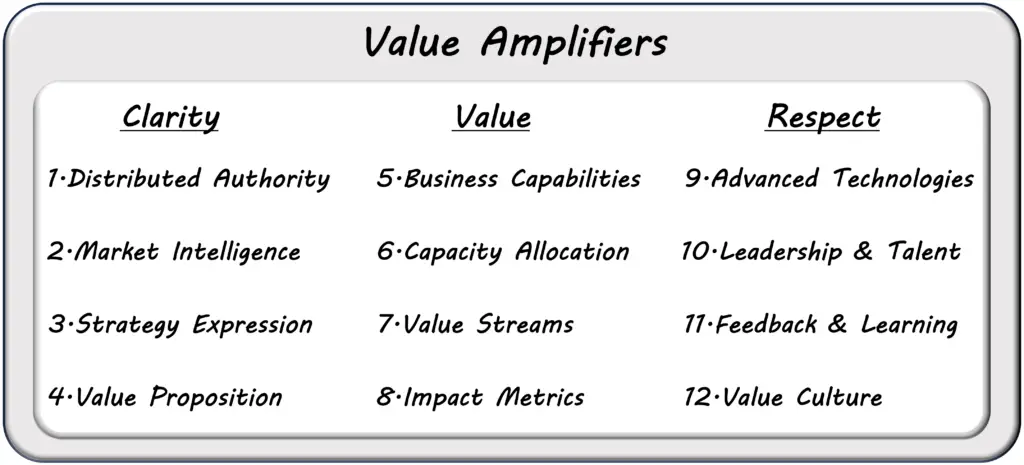
At its core, Valorys operates through twelve value amplifiers—the behavioral and structural levers that guide how value is created, encapsulated, and sustained across an organization. These amplifiers address every layer of institutional life: how decisions are made, how authority is distributed, how teams understand their own contribution, how leaders maintain alignment as conditions shift.
Each amplifier represents a dimension where organizations commonly lose ground—not through failure, but through ambiguity. The amplifiers give leaders a precise diagnostic lens: not a generic scorecard, but a structured inquiry into the specific mechanisms that are either accelerating or constraining value creation in their particular context.
One of Valorys’s central contributions is replacing intuition-driven decision-making with evidence-based judgment. These are not the same thing, and the confusion is costly.
Intuition is pattern recognition. It works in familiar conditions and fails silently in unfamiliar ones. Evidence-based judgment means something more disciplined: that every significant decision is tested against observable data, interpreted through a shared value framework, and evaluated for its likely impact on what the organization exists to create.
Valorys provides the interpretive architecture that makes this possible—not as a theoretical exercise, but as an operational discipline that can be practiced at every level of the organization.
Authority concentrates upward as complexity increases—and that concentration is one of the primary mechanisms through which value is lost. When decisions are made by people furthest from the point of value creation, those decisions structurally miss the nuances that proximity would have provided.
Valorys’s governing principle: authority should sit as close as possible to where value is created. The role of senior leadership is to provide direction and clarity, not to concentrate decision rights. This is not a management preference. It is a structural requirement for sustained performance.
In an AI-enabled world, the competitive advantage is not intelligence itself, but the capacity to employ it in service of realized value.
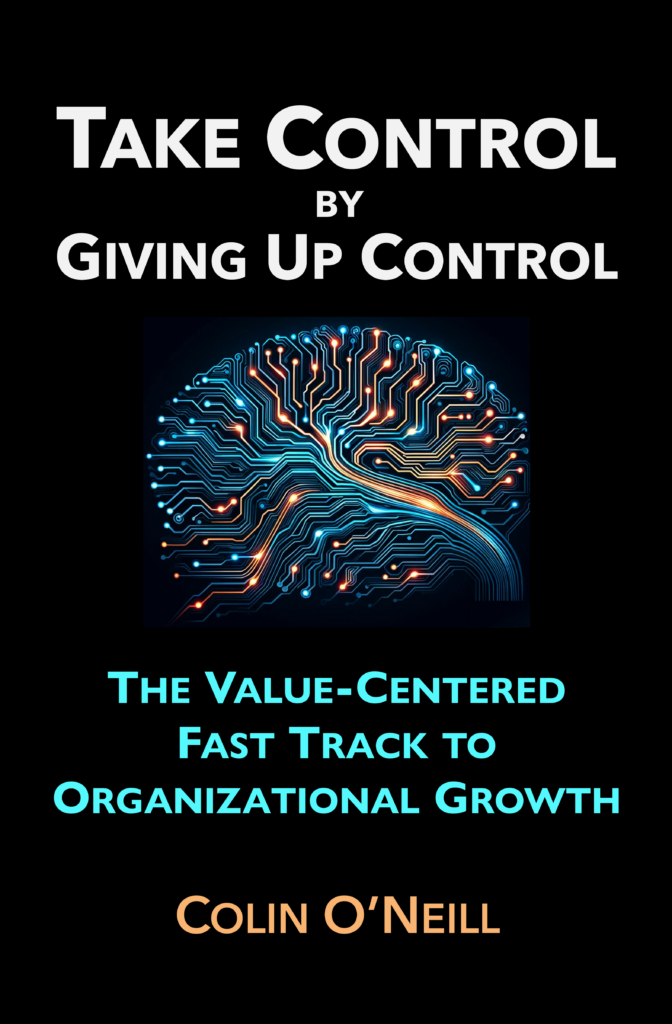
Valorys is comprehensively documented in the 300 page book Take Control By Giving Up Control: The Value-Centered Fast Track to Organizational Growth.